- Why KPIs Matter for Growing Businesses
- Essential Business Growth Metrics Every Company Should Track
- 1. Revenue Growth Rate
- 2. Customer Acquisition Cost (CAC)
- 3. Customer Lifetime Value (CLV)
- 4. Gross Profit Margin
- 5. Net Profit Margin
- Business Growth Metrics That Reveal Customer Health
- Customer Retention Rate
- Churn Rate
- Net Promoter Score (NPS)
- Operational KPIs That Support Scalable Growth
- Sales Conversion Rate
- Cash Flow
- Employee Productivity
- How to Choose the Right KPIs
- Turning Metrics Into Better Decisions
- Final Thoughts
Business Growth Metrics: Must-Have Best KPIs for Success
Business growth metrics help companies understand whether their strategies are actually producing results. Revenue may be rising, but that alone does not show the full picture. Sustainable success depends on tracking a balanced set of key performance indicators, or KPIs, that reveal how well a business is attracting customers, keeping them satisfied, controlling costs, and improving profitability over time. When leaders monitor the right data, they can make smarter decisions, spot problems early, and invest confidently in future growth.
Why KPIs Matter for Growing Businesses
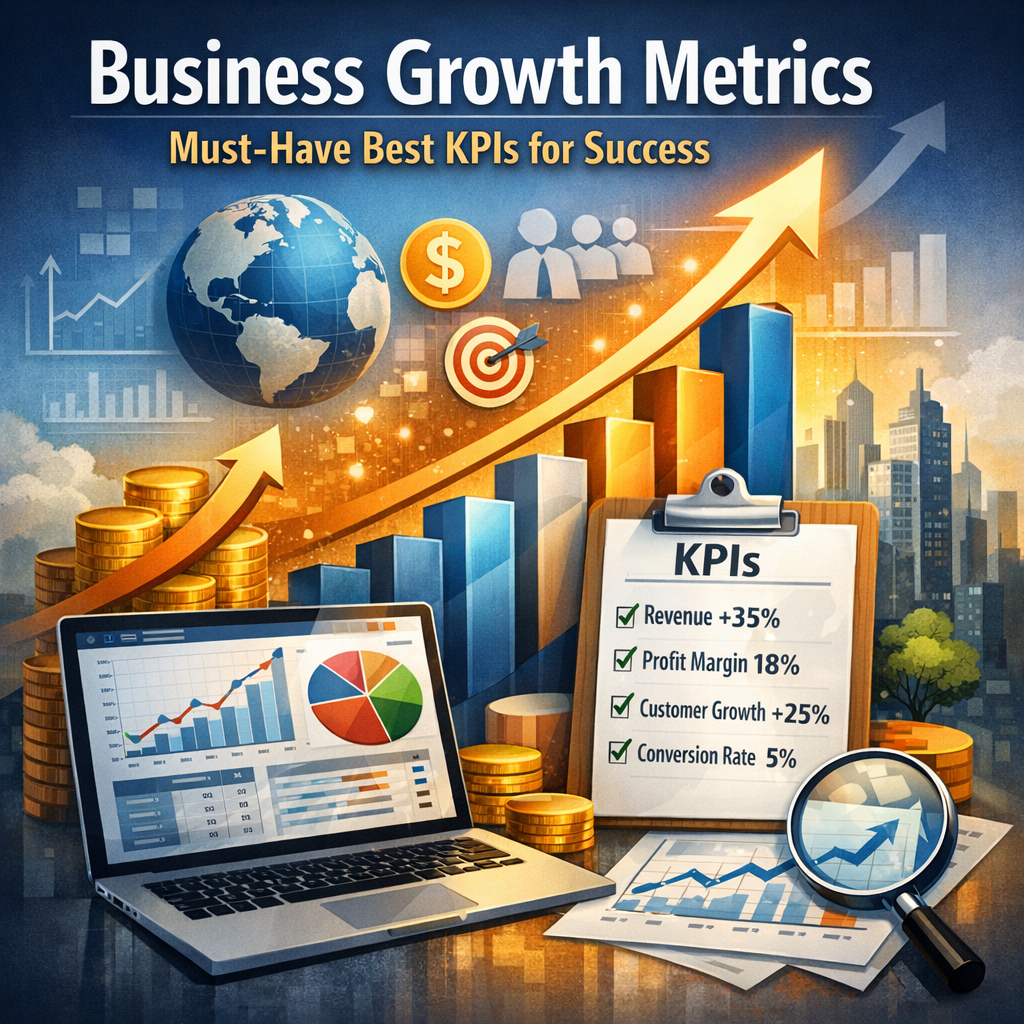
Many businesses focus on goals such as “sell more” or “expand faster,” but those goals remain vague without measurable indicators. KPIs turn ambition into something concrete. They give teams a way to evaluate progress, compare performance across periods, and understand what is driving results.
The biggest benefit of using KPIs is clarity. Instead of relying on instinct alone, business owners can answer practical questions like:
– Are we gaining customers efficiently?
– Are our current customers staying with us?
– Is growth increasing profit or just increasing expenses?
– Which marketing and sales efforts generate the best returns?
Strong KPI tracking also improves accountability. When every department understands which numbers matter most, it becomes easier to align teams around common business goals.
Essential Business Growth Metrics Every Company Should Track
Not every KPI matters equally for every company, but several core metrics are valuable across industries. These offer a broad view of performance and help businesses measure real progress.
1. Revenue Growth Rate
Revenue growth rate shows how quickly a business is increasing its sales over a specific period. This is one of the most basic indicators of expansion, but it is still one of the most important.
A simple formula is:
(Current period revenue – Previous period revenue) / Previous period revenue × 100
Tracking this monthly, quarterly, or annually helps reveal whether growth is consistent, seasonal, or slowing down. However, revenue growth should always be viewed alongside profitability and cost metrics to make sure the increase is healthy.
2. Customer Acquisition Cost (CAC)
Customer acquisition cost measures how much it costs to gain a new customer. This includes marketing spend, advertising, sales team costs, software tools, and other related expenses.
If CAC keeps rising while revenue remains flat, the business may be scaling inefficiently. A lower CAC usually means better marketing performance and stronger sales processes. This metric is especially important for startups and subscription-based businesses.
3. Customer Lifetime Value (CLV)
Customer lifetime value estimates the total revenue a business can expect from one customer over the course of the relationship. It helps determine how valuable each customer truly is, beyond the first sale.
When CLV is significantly higher than CAC, the business is usually in a healthy position. If acquisition costs are close to or greater than lifetime value, growth may become difficult to sustain.
4. Gross Profit Margin
Growing sales means little if profit margins are shrinking. Gross profit margin shows how much money remains after subtracting the direct costs of delivering a product or service.
This KPI helps businesses evaluate pricing, production efficiency, and cost management. A strong gross margin gives a company more flexibility to invest in marketing, hiring, innovation, and expansion.
5. Net Profit Margin
Net profit margin goes deeper by showing how much actual profit remains after all expenses are accounted for. This includes operating costs, taxes, interest, and overhead.
A business may appear successful on the surface because revenue is climbing, but if net profit margin is weak, the growth may not be financially sustainable.
Business Growth Metrics That Reveal Customer Health
Customer-related KPIs are some of the most powerful indicators of long-term success. They show whether a company is building loyalty or simply replacing customers as fast as it loses them.
Customer Retention Rate
Retention rate measures the percentage of customers who continue doing business with a company over time. High retention often means customers are satisfied and see ongoing value.
Improving retention can be more cost-effective than constantly acquiring new customers. Even a small increase in retention can significantly improve profitability.
Churn Rate
Churn rate is the opposite of retention. It shows how many customers stop buying, cancel subscriptions, or leave within a given period.
A high churn rate is a warning sign. It may point to issues with product quality, customer service, pricing, or market fit. Businesses with recurring revenue models should watch this especially closely.
Net Promoter Score (NPS)
NPS measures customer loyalty by asking how likely customers are to recommend a business to others. It is a useful indicator of satisfaction, brand strength, and potential word-of-mouth growth.
While NPS is not a financial metric, it often correlates strongly with future retention and expansion.
Operational KPIs That Support Scalable Growth
Growth is not just about sales. A business must also operate efficiently to scale successfully.
Sales Conversion Rate
This KPI shows how many leads or prospects turn into paying customers. A stronger conversion rate means the business is doing a better job of moving people through the sales funnel.
Tracking conversion rates by channel can help identify which campaigns, platforms, or sales tactics are producing the best outcomes.
Cash Flow
Cash flow is one of the most critical yet overlooked metrics. A business can be profitable on paper and still struggle if cash is not coming in at the right time.
Healthy cash flow ensures the company can pay suppliers, invest in growth opportunities, and survive unexpected downturns.
Employee Productivity
As businesses grow, team performance becomes increasingly important. Productivity metrics may include revenue per employee, output per team, or time to complete key tasks.
These indicators help leaders understand whether staffing levels, tools, and workflows are supporting growth or holding it back.
How to Choose the Right KPIs
The best KPIs depend on the business model, industry, and stage of growth. A startup may prioritize CAC, runway, and monthly recurring revenue, while a mature company may focus more on margin, retention, and operational efficiency.
To choose the right KPIs:
– Align them with business goals
– Keep the number manageable
– Track them consistently
– Review them regularly
– Use them to guide action, not just reporting
It is better to monitor a smaller set of meaningful KPIs than a large dashboard of numbers that no one uses.
Turning Metrics Into Better Decisions
Data is only valuable when it leads to action. Once KPIs are in place, businesses should review trends, compare results against targets, and look for the reasons behind the numbers. If acquisition costs spike, investigate campaign performance. If churn rises, gather customer feedback. If margins fall, examine pricing and operational costs.
The goal is not to track everything. It is to track what matters most and use those insights to improve performance.
Final Thoughts
Growth becomes far more manageable when it is measured properly. The right KPIs give business owners and leaders a clear view of what is working, what is underperforming, and where to focus next. By monitoring revenue, profitability, customer behavior, and operational efficiency, companies can build a stronger foundation for long-term success.
Instead of relying on assumptions, make decisions based on evidence. That is how businesses grow with confidence, control, and consistency.